Hybrid Industrial Flooring: Why Epoxy Polyurethane Hybrid Flooring Is Redefining Industrial Floor Performance
In most cases, the different technologies used for traditional floors require the facility owner to either sacrifice the resistance to compression that epoxy resists or the flexibility that a polyurethane floor has. But, in today’s industrial settings, a solution is required that integrates the best of both technology types.
This need has resulted in the creation of a Hybrid Industrial Flooring, also referred to as Epoxy Polyurethane Hybrid Flooring (EPU Hybrid Flooring). Hybrid floors combine the epoxy and polyurethane chemistries in one flooring solution, resulting in higher durability, chemical resistance, thermal performance, and lifecycle values.
What Is Hybrid Industrial Flooring?
Hybrid Industrial Flooring is a hybrid technology of epoxy resin and polyurethane resin in one flooring system.
The goal of an Epoxy Polyurethane Hybrid Flooring system is to take advantage of:
• The compressive strength and adhesion property of epoxy
• The flexibility and thermal resistance of polyurethane
• Enhanced impact resistance
• Improved crack-bridging capability
• Superior long-term durability
Conventional epoxy flooring systems might develop brittleness during thermal cycling, whereas hybrid flooring systems are designed to deal with shifting of the substrate yet have exceptional wear resistance.
Understanding the Chemistry Behind Epoxy Polyurethane Hybrid Flooring
Epoxy Component
The properties of epoxy resins that make them a popular choice for industrial flooring include:
• High compressive strength
• Excellent substrate adhesion
• Superior abrasion resistance
• Good chemical resistance
• Low shrinkage characteristics
But epoxy systems may have the characteristics:
• Limited flexibility
• Reduced thermal shock resistance
• Brittleness of material under impact loading
Polyurethane Component
Polyurethane flooring systems are characterized by:
• Elasticity and flexibility
• Thermal shock resistance
• Impact resistance
• Crack-bridging capability
• Resistance to cyclic loading
But stand-alone polyurethane systems may not be as compressive as heavy-duty epoxy systems.
The Hybrid Advantage
Combined with both resin technologies, EPU Hybrid Flooring offers a balanced performance profile which includes:
Mechanical Benefits
• High compressive strength
• Improved tensile strength
• Enhanced flexural strength
• Better impact absorption
Environmental Benefits
• Resistance to heat and cold
• Minimize the risk of cracking
• Improved performance in varying temperatures
Operational Benefits
• Extended service life
• Reduced maintenance costs
• Lower lifecycle expenditure
Technical Characteristics of EPU Hybrid Flooring
High Mechanical Strength
Industrial facilities floors are frequently exposed to:
• Forklift traffic
• Pallet trucks
• Automated Guided Vehicles (AGVs)
• Heavy machinery loads
• Dynamic point loading
Hybrid flooring systems usually have high compression capacity and are sufficiently flexible to withstand stresses from operations.
Performance Advantages
• Reduced surface cracking
• Improved load distribution
• Enhanced wear resistance
• Long-term dimensional stability
Superior Thermal Shock Resistance
Epoxy Polyurethane Hybrid Flooring‘s resistance to rapid temperature changes is one of its key advantages for industries.
Typical Thermal Stress Sources
• Steam cleaning
• Hot water washdowns
• Furnace operations
• Cold storage transitions
• Food processing equipment
Whether due to thermal shock or other factors, traditional epoxy floors can crack over time. This risk is dramatically lowered with the addition of polyurethane technology to hybrid flooring products.
Enhanced Chemical Resistance
Industrial floors are often subjected to harmful chemicals such as: Acids, Alkalis, Solvents, Oils, Grease, Cleaning agents, etc.
A good hybrid flooring system will provide good chemical resistance with a structurally sound system.
Industries Benefiting from Chemical Resistance:
• Chemical processing plants
• Pharmaceutical facilities
• Fertilizer manufacturing units
• Petrochemical plants
• Battery manufacturing facilities
Improved Impact Resistance
Impact loading is common in industrial environments- Falling tools, Steel component handling, Container movement, Material loading operations, etc.
The polyurethane material has good energy absorption properties, and the epoxy material has good structural strength.
This combination can be very helpful in minimizing surface damage and early failure.
Crack Resistance and Substrate Movement Accommodation
Concrete substrates naturally experience- Shrinkage, Expansion, Contraction, Structural vibration, etc.
Traditional rigid flooring systems may transfer these stresses to the surface layer.
How Hybrid Flooring Solves This Challenge?
The polyurethane component introduces flexibility into the flooring matrix, allowing the system to:
• Absorb stress
• Accommodate minor substrate movement
• Reduce reflective cracking
• Improve long-term durability
Importance in Regulated Industries
Industries operating under GMP, HACCP, and ISO requirements require hygienic flooring systems.
Hybrid flooring systems provide a dense, seamless surface that supports stringent hygiene standards.
Typical Applications of Epoxy Polyurethane Hybrid Flooring
Food Processing Facilities
Challenges:
• Hot water cleaning
• Organic acids
• Continuous traffic
Benefits:
• Thermal shock resistance
• Chemical resistance
• Hygienic performance
Pharmaceutical Manufacturing
Requirements:
• Cleanability
• Chemical resistance
• Durability
Benefits:
• Seamless surfaces
• Low maintenance
• Regulatory compliance support
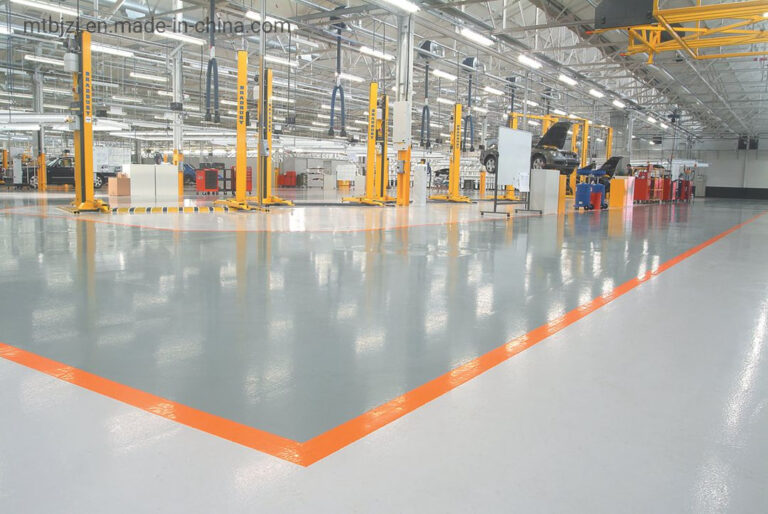
Automotive Manufacturing Plants
Challenges:
• Heavy equipment
• Oil exposure
• Abrasion
Benefits:
• High load-bearing capacity
• Impact resistance
• Long service life
Chemical Processing Plants
Requirements:
• Acid resistance
• Solvent resistance
• Structural durability
Benefits:
• Chemical protection
• Reduced maintenance downtime
Warehouses and Logistics Centers
Challenges:
• Continuous forklift traffic
• Dynamic loading
• Heavy storage systems
Benefits:
• Abrasion resistance
• Impact resistance
• Reduced repair requirements
Floorkrete’s Hybrid Flooring Solution
Floorkrete offers advanced Hybrid Industrial Flooring solutions under the Floorcem range. Designed for demanding industrial environments, Floorcem combines the performance advantages of epoxy and polyurethane technologies to deliver exceptional mechanical strength, abrasion resistance, chemical resistance, and long-term durability.
Floorcem Product Range:
FloorCEM NPU-10: Two-component polyurethane-modified epoxy self-smoothing hybrid coating for floors and walls in chemical, pharmaceutical, healthcare, food processing, warehouse, and laboratory environments. Applied seamlessly in thicknesses of 0.3–1.0 mm.
FloorCEM EPU-5: High-performance three-component epoxy-polyurethane self-smoothing screed for heavy-duty industrial flooring. Applied seamlessly in thicknesses of 1.5–5.0 mm.
FloorCEM EPU-2: Flexible three-component epoxy-polyurethane self-smoothing hybrid flooring system providing a seamless, durable, and chemical-resistant finish. Applied in thicknesses of 1.0–2.0 mm.
FloorCEM EPU-1: Two-component epoxy-polyurethane self-smoothing screed for factories, warehouses, clean rooms, food processing, pharmaceutical, and industrial areas. Applied seamlessly in thicknesses of 0.5–1.0 mm.
Frequently Asked Questions (FAQs)
1. What is Hybrid Industrial Flooring?
Hybrid Industrial Flooring is a flooring system that combines epoxy and polyurethane resin technologies to achieve high strength, flexibility, thermal resistance, and chemical resistance in a single flooring solution.
2. What is Epoxy Polyurethane Hybrid Flooring?
Epoxy Polyurethane Hybrid Flooring (EPU Hybrid Flooring) is an advanced industrial flooring system that integrates epoxy’s mechanical strength with polyurethane’s flexibility and thermal shock resistance.
3. Where is EPU Hybrid Flooring commonly used?
EPU Hybrid Flooring is widely used in food processing plants, pharmaceutical facilities, chemical industries, automotive manufacturing units, warehouses, and logistics centers.
4. What is the expected service life of Hybrid Industrial Flooring?
When properly specified and maintained, hybrid flooring can provide long-term performance with reduced maintenance requirements.
5. Why choose Hybrid Industrial Flooring over traditional epoxy flooring?
Hybrid flooring offers better thermal shock resistance, improved flexibility, higher impact resistance, reduced cracking, and longer service life while maintaining excellent mechanical strength.