Understanding the Science Behind ESD Flooring
In modern electronics manufacturing, laboratories, and data-sensitive environments, controlling electrostatic discharge (ESD) is not simply a safety measure—it is a critical part of infrastructure design. ESD flooring systems play a vital role in safely dissipating static electricity, ensuring controlled environments for sensitive operations. Even a tiny electrical discharge can spoil delicate electronic parts, upset instrumentation, or even trigger explosive conditions.
Understanding the Science Behind ESD Flooring
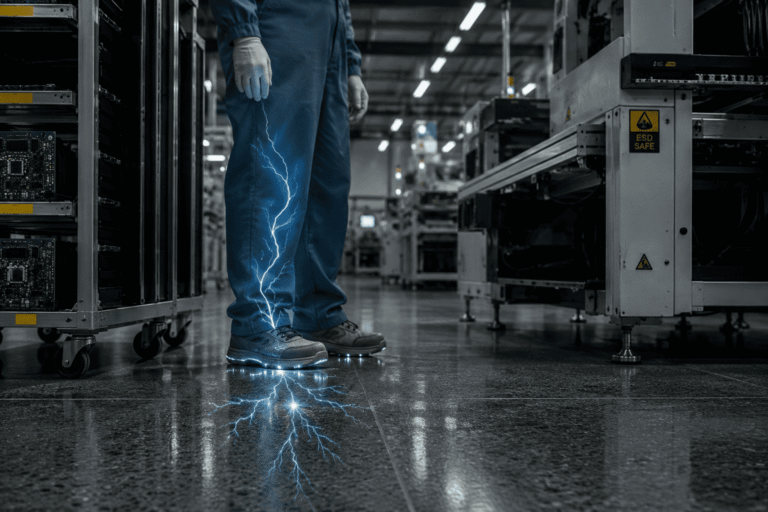
The accumulation of static electricity occurs when two materials have been in contact and are separated. This phenomena has a frequent occurrence in industrial settings, where there is movement, friction, and synthetic materials.
An ESD flooring system operates by establishing a controlled electrical circuit which safely conducts these charges to the grounding network.
Common levels of resistance are:
● Conductive flooring: ~10³ to 10⁶ ohms
● Static dissipative flooring: ~10⁶ to 10⁹ ohms
Such levels of resistance enable the dissipation of the statical charges but without causing hazardous electrical shocks.
Performance Characteristics of High-Quality ESD Flooring
Industrial flooring systems are engineered not only for electrical performance but also for mechanical durability.
Key technical properties typically include:
● Compressive strength: Often exceeding greater than 30–60 N/mm²
● Large resistance to abrasion of heavy foot traffic and equipment movement
● Resistance to industrial chemicals, oils, and fuels
● Smooth finish that minimizes dust build-up and contamination
● Dimensional stability with minimal shrinkage after curing
These properties ensure that this flooring can be used in harsh industrial conditions and still retain services in the electrical setup.
Where ESD Flooring Is Most Critical
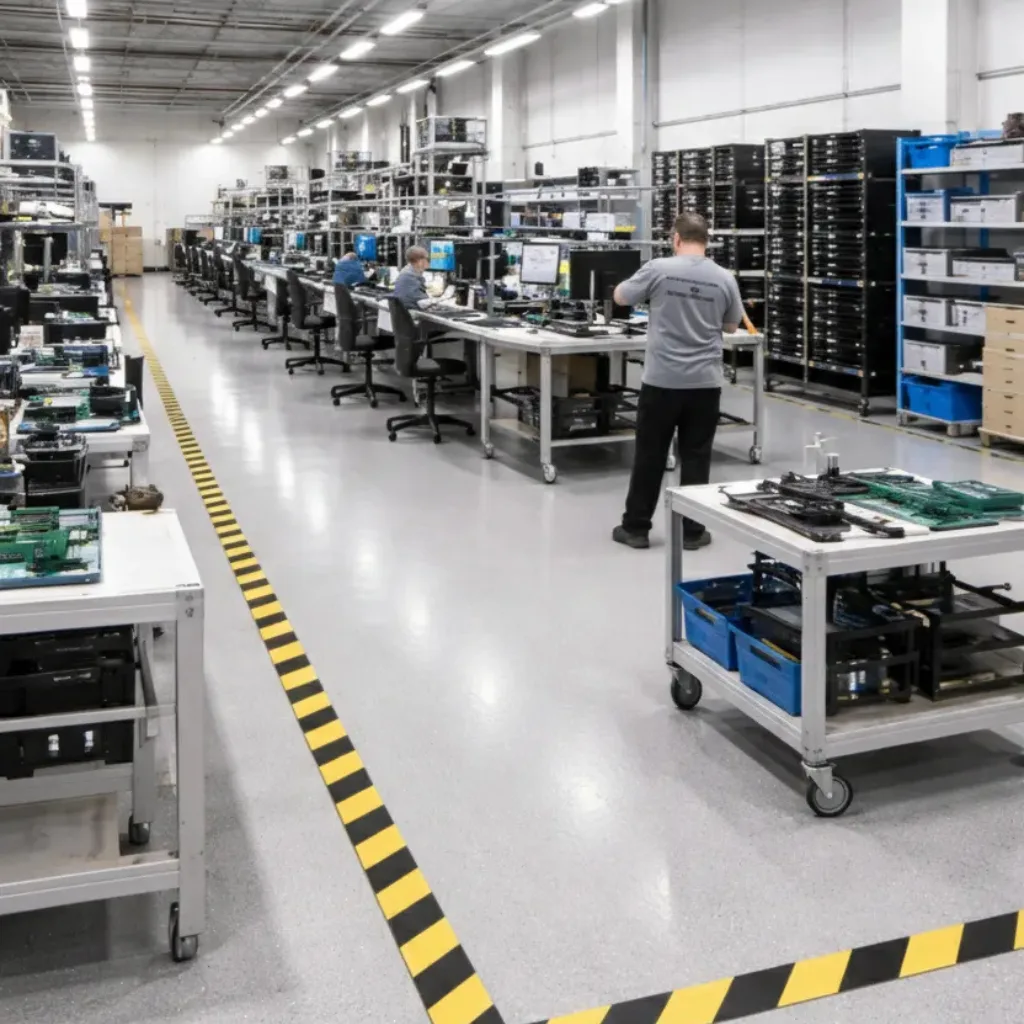
This form of flooring is highly specified in those areas where even minor occurrences of electrostatic can result in any operational or financial losses.
Typical applications include:
• Electronics manufacturing plants
• Semiconductor fabrication facilities
• Pharmaceutical laboratories and clean rooms.
• Data centers and server rooms
• Aerospace and defense plants
• Quality control laboratories
• Warehouses storing sensitive electronic components

How Long Does ESD Flooring Last?
Its lifespan will depend on various factors such as the quality of installation, the condition of the substrate, the traffic load, and the maintenance practices.
The systems are usually capable of providing when installed and well maintained:
In moderate industrial conditions a life of 10-15 years of service.
7-10 years in heavy manufacturing areas of high traffic.
Nonetheless, mechanical durability is not as crucial as electrical performance of the floor. Over time, contamination from dust, oils, or cleaning chemicals can affect surface resistance.
Epoxy vs Polyurethane
Different chemistries are used depending on performance requirements.
Epoxy ESD Flooring
Best suited for rigid industrial environments.
Advantages:
● High compressive strength
● Superior chemical resistance
● Hard-wearing surface for heavy traffic
Typical use cases:
● Electronics manufacturing
● Industrial assembly lines
● Control rooms
Polyurethane ESD Flooring
Preferred where flexibility or crack-bridging is required.
Advantages:
● Slightly flexible structure
● Better impact resistance
● Improved tolerance to substrate movement
Typical use cases:
● Laboratories
● Aerospace facilities
● Controlled environments with temperature variation
The Strategic Value:
For industries working with sensitive electronics, explosive materials, or high-precision instruments, ESD flooring is not simply a flooring upgrade. It is a risk mitigation strategy.
A properly designed system helps organizations:
● Protect expensive electronic components
● Reduce product rejection and manufacturing losses
● Maintain compliance with ESD standards
● Improve operational reliability in controlled environments
In high-tech manufacturing ecosystems, the floor itself becomes part of the electrostatic protection system (EPS) quietly ensuring safety and performance every day.
ElectroShield flooring systems offer a complete range of static-control solutions
ELECTROSHIELD ELD5406-
A high-performance three-component epoxy floor coating designed to work effectively with both conductive and nonconductive ESD footwear.
FloorThane Electroshield UD 5410-
A high-solids polyurethane floor coating that offers a strong yet flexible antistatic finish for demanding industrial and commercial environments.
FloorThane Electroshield ULD 5411-
based on polyurethane resin,is a three-component, It is a very low-odor, chemical-resistant, aliphatic polyester ESD urethane coating. A low-odor, chemical-resistant, three-component polyurethane ESD coating based on aliphatic polyester technology.
FloorShield ElectroShield ELC-5407-
A high-performance, provide electrostatic conductivity on both conductive and non-conductive substrates.
FloorThane Electroshield ULC 5412-
A high-performance system designed to provide electrostatic conductivity on conductive and non-conductive substrates.
ElectroShield ULC5416-
A high-build, two-component polyurethane floor topping (0.5–2 mm) designed for electrostatic control.
Electroshield ETC5400 –
A two-component conductive epoxy primer and sealer used in Floorkrete ElectroShield ESD flooring systems.
FAQ
1. Where is ESD flooring commonly used?
ESD flooring is typically used in electronics manufacturing plants, cleanrooms, data centers, laboratories, aerospace facilities, and environments where static discharge can damage equipment or materials.
2. How does ESD flooring work?
ESD flooring works by creating a controlled conductive path that allows static electricity generated by people or equipment to safely dissipate into the grounding system.
3. How long does ESD flooring last?
With proper installation and maintenance, high-quality ESD flooring can typically last 10–15 years in industrial environments.
4. Is maintenance required for ESD flooring?
Yes, regular cleaning with approved conductive cleaners and periodic resistance testing are recommended to maintain the electrical performance of ESD flooring.
5. What is the typical thickness of an ESD flooring system?
Most resin-based ESD flooring systems are installed at a thickness of around 1.5–2 mm, depending on the system design and performance requirements.