Polyaspartic Vs Polyurea : What’s the Difference and Which One Should You Choose?
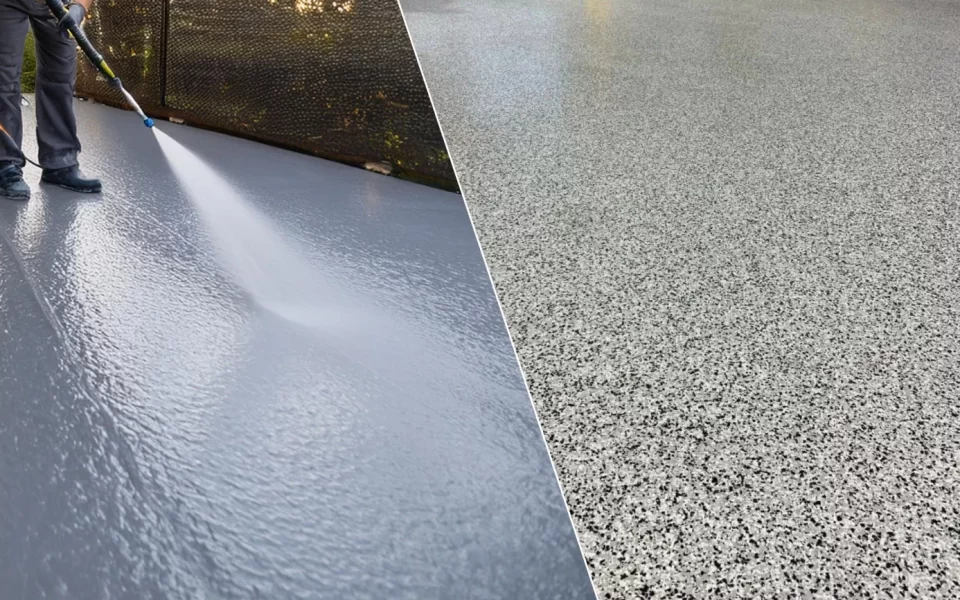
When it comes to high-performance coatings, two terms often stand out in industrial and commercial applications: Polyurea and Polyaspartic Polyurea. While they may sound similar, these technologies have distinct properties that suit different needs. Whether you’re working on waterproofing, concrete protection, or floor coatings, understanding the difference is critical to selecting the right solution.
What is Polyurea and Polyaspartic Polyurea?
Polyurea is a high-performance two-component elastomer derived from the reaction of an isocyanate component and a resin blend. This rapid reaction is widely used in infrastructure, waterproofing, industrial flooring, and protective coatings due to its rapid cure time, flexibility, and chemical resistance. It is often applied using a plural spray. Polyurea systems are known for their extremely fast curing time (sometimes just a few seconds) making them ideal for projects requiring quick turnaround. The cured layer of polyurea offers excellent elongation, crack-bridging, and waterproofing properties, and can be applied even under extreme temperature and humidity conditions.
On the other hand, Polyaspartic Polyurea is a more advanced, aliphatic version of polyurea chemistry. It is created by reacting an aliphatic isocyanate with a polyaspartic ester, which slows down the reaction time significantly compared to traditional spray applied polyurea. This modified and controlled reactivity allows for a longer pot life and more manageable working time, making it suitable for roller or brush application in addition to spray. Polyaspartic coatings are inherently UV-stable, offer a high-gloss finish, and maintain color clarity over time, making them especially popular in decorative flooring and exterior applications. While they may not cure as quickly as pure polyurea, they strike a balance between fast installation, visual appeal, and long-term durability.
Head-to-Head Comparison:
| Property | Polyurea (Spray Applied) | Polyaspartic Polyurea |
| Cure Time | Very fast (seconds) | Fast (minutes) |
| Application Method | Spray (plural-component) | Spray or roller |
| UV Resistance | Poor (requires topcoat) | Excellent |
| Gloss & Clarity | Moderate | High |
| Working Time | Short | Long (easier for large areas) |
| Installation Cost | Higher (due to equipment) | Slightly lower |
| Durability | Excellent | Excellent |
| Use Case | Industrial waterproofing, roofing, tanks lining | Decorative floors, garages, balconies, waterproofing |
Multichem’s Advanced Product Portfolio:
At Multichem Group, we have developed a comprehensive range of polyurea and polyaspartic waterproofing systems under trusted brands like Armourtuff®, Armourthane®, Ultrathane®, and Multithane®. These are offered in pure, hybrid, and spray-applied formats to meet every project requirement:
 Pure Polyurea Waterproofing – Liquid Applied Systems
- Armourthane® Sulabh– A fast-curing, high-performance polyurea membrane offering >5 MPa tensile strength and >400% elongation. Ideal for seamless, rubber-like waterproofing.
- Armourthane® Viraj– Designed with leafing pigments and reinforcing additives, this durable elastomeric coating delivers >11 MPa tensile strength and >350% elongation.
- Armourthane® Vajra– Formulated with aliphatic polyurea chemistry, Vajra is perfect for exterior use, boasting >15 MPa tensile strength and >300% elongation.
- Multithane®– A high-solids, brush- or spray-applied pure polyurea system offering a remarkable elongation of >600%, built for high-build, crack-resistant waterproofing.
Hybrid Polyurea Formulations – Liquid Applied Systems
- Ultrathane® 950– Delivers >9 MPa tensile strength and >500% elongation; ideal for demanding surfaces requiring elasticity and durability.
- Ultrathane® 1250– Designed for adhesion to complex substrates including metal, tiles, and concrete, with >12 MPa tensile strength and >500% elongation.
- Ultrathane® 1530– Suited for UV-exposed roofs and terraces, this hybrid coating resists temperature extremes with >15 MPa tensile strength and >300% elongation.
Pure Polyurea Waterproofing – Spray-Applied Systems
- Armourtuff® P2119– A high-performance spray coating with 21 N/mm² tensile strength and 190% elongation—ideal for below-grade waterproofing, podiums, and flower beds.
- Armourtuff® P2440– Combines a robust tensile strength of 24 N/mm² and >400% elongation, making it suitable for water tanks, bridge piers, and high-traffic rooftops.
Hybrid Polyurea Waterproofing – Spray-Applied Systems
- Armourtuff® H1255– Offers >500% elongation and 12 N/mm² tensile strength; forms an elastic membrane even on irregular surfaces like green roofs and complex geometries.
- Armourtuff® H1535– A high-performance hybrid coating with 15 N/mm² tensile strength and >350% elongation, ideal for waterproofing large concrete surfaces with flexibility.
Polyaspartic Polyurea Systems –
- Armourthane® FLEX1515– A fast-curing, two-component waterproofing polyaspartic coating that offers UV resistance, stain resistance, and hot-tire pickup resistance. Walkable in just 3 hours, it is perfect for Floorkrete systems like MultiFlakes, StoneSho, and MultiQuartz.
- Armourthane® GUARD– A UV-stable, aliphatic polyaspartic sealer suitable as primer, mid, or topcoat for floors. With quick recoat time and excellent chemical resistance, it is ideal for car parks, ramps, stadiums, and wash areas—even over metal surfaces using zinc-rich primers like MetaPrime®
 Choose Polyurea if:
- You need ultra-fast return-to-service.
- Your project involves large, industrial, or infrastructure areas.
- Application conditions are extreme (very hot or cold).
- Flexibility and elongation are a priority
Choose Polyaspartic Polyurea if:
- Aesthetics, gloss, or UV stability matter
- You prefer roller/brush application instead of spray.
- You’re installing decorative or commercial floors with specific color or design needs.
Conclusion
Both Polyurea and Polyaspartic Polyurea offer world-class performance in demanding environments. The best choice depends on your project requirements, application method, and environmental conditions. Polyurea leads in speed and flexibility, while Polyaspartic Polyurea shines in ease of application and UV resistance.
If you’re unsure which system suits your needs, consult Multichem Group, Our team of specialists is ready to guide you through every layer of protection.
Contact us at info@multichemgroup.net/ 9619091025
Recent Post